
Photo by Richard Deng on Unsplash
Roofing
How to Choose a Roofing Contractor in the Twin Cities: Licenses, Permits, and Bids
What to check before you sign a roofing contract in the Twin Cities, with findings from our records on 382 roofing companies and the permit rules of 68 metro cities.
From this directory’s own records on 431 companies and 68 city permit pages. Data checked September 28 – November 18, 2026. Sources
Which license the job needs
Three DLI license types let a company contract with you directly for a roof. They stop being interchangeable once the job grows past shingles.
Residential building contractor BC
Covers: roofing plus gutters, soffit, fascia, siding, windows, and new construction
Recovery Fund: covered
Residential remodeler CR
Covers: the same work on existing homes; no new homes or detached garages
Recovery Fund: covered
Residential roofer RR
Covers: roofing only. DLI says a licensed roofer cannot contract to install gutters, downspouts, soffit, or fascia
Recovery Fund: not covered; DLI lists a $15,000 surety bond among the license requirements
Contractor registration IR
Covers: nothing on its own; it is not a license, and DLI says homeowners should not hire based on registration alone
Recovery Fund: not covered
Sources: DLI’s residential contractor licensing and roofer license pages and the Contractor Recovery Fund page. The fund statute, Minn. Stat. 326B.89, defines a covered licensee as a residential building contractor or remodeler.
What our records show. Of the 382 companies in this directory that list roofing on their own websites, 98% hold a building contractor or remodeler license, and 6 hold a residential roofer license.1 Across all 431 listed companies, 18 hold only a registration; the full breakdown is on our Minnesota contractor license data page.
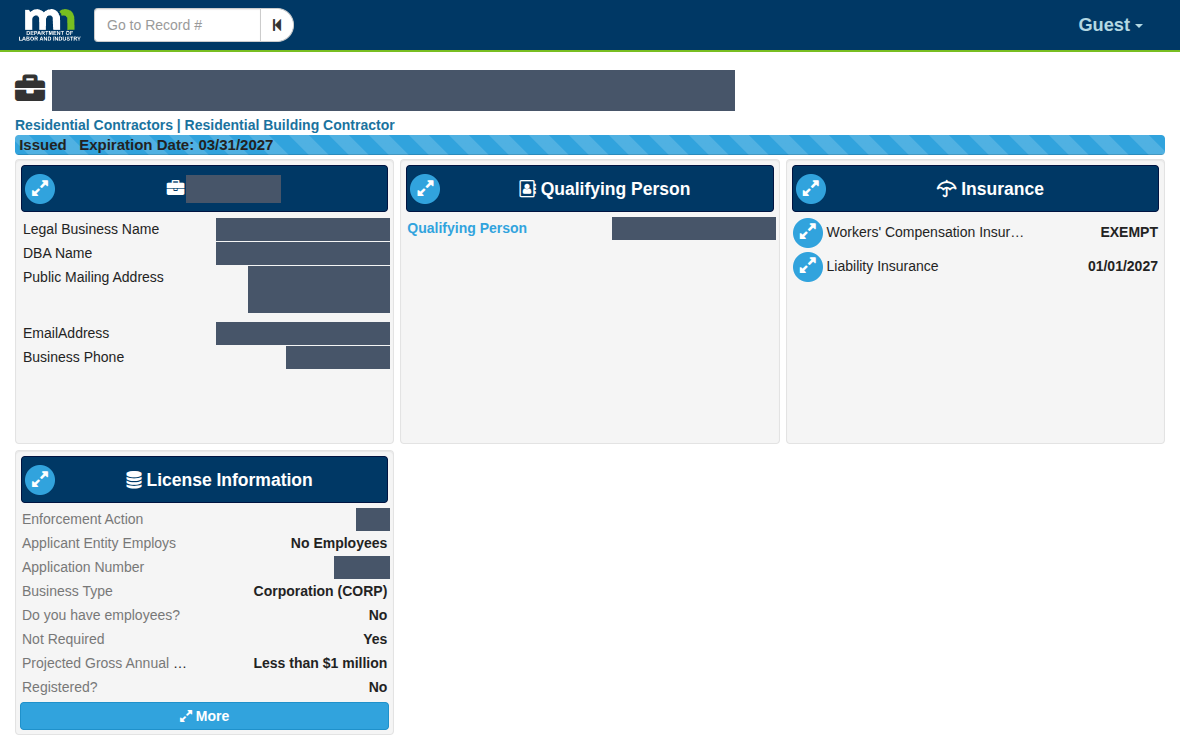
- License type. This record is a residential building contractor (BC). Hold it against the work in the bid, using the license cards above.
- Status and expiration date. Check both on the day you sign, not only when the bid arrives.
- License number. Blacked out here. The number on your contract should bring up this same record.
- Insurance. What the company has on file with DLI: here, a date beside its liability policy and a workers' compensation exemption. Ask for a certificate of insurance as well.
- Employees. This company answered No Employees, and its workers' compensation shows EXEMPT. If a crew shows up, ask who employs them and whose workers' compensation covers them.
What roofing companies list
We read each listed company’s own website for the services it names. These are counts of what companies say they do, not a test of how well they do it.
Most roofing companies in the metro are whole-exterior companies: 96% of these also list siding. That’s convenient for a storm job that hits the roof, siding, and gutters at once, and it is also why the license question above comes up so often.
Manufacturer programs
135 listed companies appear on at least one roofing manufacturer’s contractor locator.3
Program levels such as “Master Elite” or “Emerald Pro” are each manufacturer’s own commercial program tiers, not quality ratings, and we don’t rank by them. They matter in one place: if a bid promises a manufacturer’s extended warranty, ask for that warranty document and read what it requires of the installer.
How the cities differ on a re-roof
While writing our city pages we read the building department pages, handouts, and fee schedules of 68 Twin Cities cities and recorded each rule with its source; for this guide we reread the live pages for 9 of the cities below.4 A city missing from a list may simply not say so on the pages we read, so call the building department before you sign. Delano’s sheet, for one, says it is a guide only and does not contain every code requirement.
Can new shingles go over the old ones?
Burnsville, Delano, Eagan, Forest Lake, Oak Park Heights, Rosemount, St. Francis, and West St. Paul
The state’s own shingle handout says an overlay can cost less but isn’t always the better choice, and requires a tear-off when the roof already has two or more layers or is water-soaked or deteriorated. Several cities go further. Burnsville’s and Delano’s sheets say the building code’s hail map puts Dakota and Wright Counties in a moderate hail area and bar overlays for that reason. Lakeville’s 2016 guide, in Dakota County too, sets conditions instead, and Forest Lake’s no-overlay sheet dates from 2016 and cites a 2006 code. Where two documents disagree, the building department’s current answer is the one that counts, so ask it, and make sure every bid says tear-off or overlay in writing.
How does the city check the layer you'll never see?
Afton, Apple Valley, Burnsville, Delano, Eagan, East Bethel, Forest Lake, Lakeville, Minnetonka, Rosemount, Spring Lake Park, and West St. Paul
New Prague, Oak Park Heights, Rosemount, St. Francis, and St. Paul
The city roofing sheets we read that address it, and the state handout, all run the ice barrier from the eave edge to a point two feet or more inside the house’s exterior wall. Once shingles are on, nobody can see it, which is why 12 cities rely on photos and 5 send someone before the roof is covered. St. Paul’s policy says the inspector must be called before work begins. Ask for copies of whatever photos your contractor submits; they are a record of the part of the roof you paid for and will never see.
Who deals with the permit?
Anoka, Brooklyn Center, Coon Rapids, Delano, Elk River, Minnetonka, New Prague, Prior Lake, and Vadnais Heights
Afton, Brooklyn Center, Centerville, East Bethel, Hanover, Lakeland, Minnetonka, North Oaks, Spring Lake Park, St. Francis, and West St. Paul
What does the permit cost?
Centerville, Chaska, Hanover, Independence, Lakeland, Oak Park Heights, Prior Lake, Rosemount, St. Michael, and West St. Paul
Afton, Delano, Farmington, Mendota Heights, North Oaks, Ramsey, and Spring Lake Park
Reading a bid
Two bids for “a new roof” can describe different jobs. Line them up on these points before comparing totals:
Tear-off or overlay
And how many layers come off. Your city may decide this for you; the bid should still say it.
Deck repair
Damaged sheathing gets replaced, and St. Paul's policy says gaps wider than 5/8 inch between deck boards must be filled or covered. Ask how bad decking found after tear-off is priced, per sheet or per hour.
Ice barrier
Where it goes (eaves, valleys) and how the city will see it: photos or an inspection visit.
Ventilation
Whether vents are added or changed, and whether your city requires an upgrade on a tear-off.
Flashing
Whether old flashing is reused. Rosemount's page and the state handout say rusted or damaged flashing isn't reinstalled.
The shingle
Brand and product line by name. The state handout says the package label must show a wind design speed of at least 115 mph.
Permit
Who pulls it, and that the fee is listed.
Warranty
The workmanship warranty in the contract, and the manufacturer warranty as its own document.
DLI’s tips for hiring a contractor list what the contract should include before you sign: a detailed summary of the work, a description of materials, the total price or how it will be calculated, a payment schedule, specific timelines and what happens if they slip, and a requirement that every change be a written change order you sign. Our broader post on choosing exterior renovation contractors covers comparing estimates across trades.
After a storm: slow down on paper
New Prague’s storm-damage advice is the permit advice above: have your licensed contractor pull the permit, keep the permit card on site, and remember the job isn’t complete until the final inspection is approved.
Questions to ask, and why
About the license
Which license number goes on the contract, and does it cover everything in this bid? A roofer license doesn't cover gutters, soffit, or fascia.
Is the business name on the license the same as on the bid and insurance certificate? DLI says a licensee may only do business under the exact name on its Secretary of State filing.
About the permit
Who pulls the permit, and in whose name? East Bethel and New Prague both tie responsibility for the work to the permit holder.
Does my city allow an overlay here, and is this bid a tear-off? 8 cities we read bar overlays; others set conditions.
How will the ice barrier be inspected, and can I have the photos? 12 cities use photos for it.
About the roof
Do you do repairs, or replacements only? 26% of roofing companies here list replacement without repair.
How is bad decking priced if you find it? Damaged sheathing has to be replaced, and nobody knows how much until the old roof is off.
Which shingle, and what wind rating does the label show? The state handout sets a 115 mph floor for the label.
If you're promising a manufacturer warranty, may I see the document? Program tiers are the manufacturer's commercial levels; the warranty terms are in the manufacturer's paper, not the sales pitch.
After a storm
Is what you're asking me to sign a contract? DLI says authorization forms usually are.
How we compiled this
This directory lists exterior contractors that serve the Twin Cities. It does not vet, endorse, rank, or recommend them; featured placement, when it exists, is paid and labeled. The numbered notes below are the sources behind the small numbers on this page. Roofing listers are counted with the same test as our roofing contractors page, and license counts by type for every listed company are on the license data page.
- Companies and licenses: All 431 listed companies, matched to Minnesota DLI license records and checked November 16 – November 18, 2026. Roofing listers are the 382 companies whose own websites list at least one roofing service.
- Services: Read from each company's own website, September 28 – November 18, 2026. We count what a company says; we don't inspect work.
- Manufacturer programs: From the manufacturers' online contractor locators, checked October 5, 2026.
- City rules: From the building department pages, handouts, and fee schedules of 68 cities, read October 9 – November 8, 2026 for our city pages, each claim recorded with its source and check date. 9 of the cities named here were reread on their live pages on November 8, 2026.
Not used: ratings, review counts, complaint or enforcement records, and company names. No company is singled out as an example. Where two city documents disagree, we say so rather than pick one.
Counts on this page update when our records are refreshed. How this directory works lists every source and how often it is checked.
Update log
- November 8, 2026: First published.
- November 10, 2026: Added new city hub data.
- November 19, 2026: Added new contractors.
FAQs
- Does a Minnesota roofer license cover gutters?
- No. DLI says a licensed roofer cannot contract to install gutters, downspouts, soffit, or fascia; that work needs a building contractor or remodeler license instead. Of the 382 companies in our directory that list roofing on their own websites, 98% hold one of those broader licenses and 6 hold a roofer license, based on DLI records checked November 16 - November 18, 2026.
- Can a roofer put new shingles over my old roof in the Twin Cities?
- It depends on the city. Of the 68 metro cities whose permit pages we read, 8 bar asphalt shingle overlays outright, while 4 require a tear-off only under listed conditions, such as two existing layers. Neighboring cities in the same county sometimes disagree, so ask the building department which rule applies and get tear-off written into the bid.
- Who should pull the roofing permit, the homeowner or the contractor?
- Usually the contractor. Of the cities we read, 9 say the permit goes to, or should be pulled by, whoever does the work. New Prague warns that a homeowner who pulls the permit becomes responsible for the contractor's work, and 11 cities ask for the contractor's license number or proof of it on the application.
- Do most roofing companies also do roof repairs?
- Most say so, not all. Among the 382 directory companies that list roofing on their own websites, 73% list roof repair, while 100 (26%) list replacement but not repair. A missing listing does not prove a company won't fix a leak, so for a repair, ask directly before booking an inspection.
- Can a roofing contractor pay my insurance deductible in Minnesota?
- No. Minnesota Statutes section 325E.66 bars residential contractors, roofers included, from promising to pay all or part of an insurance deductible as an inducement to hire them, or offering compensation for an inspection, a claim, or a referral. DLI says contractors doing insurance work must include written notice of the law with their initial estimate.
- What does a city roofing inspection check in the Twin Cities?
- Mostly what disappears under the shingles. Of the cities we read, 12 use photos of the ice barrier at the eaves as part of the inspection, and 5 send an inspector before the shingles cover the underlayment or deck. Ask your contractor which method your city uses and for copies of any photos they submit.
Sources
- Minnesota DLI: Residential contractor licensing
- Minnesota DLI: Roofer license
- Minnesota DLI: License and registration lookup
- Minnesota DLI: Contractor Recovery Fund
- Minnesota Statutes 326B.89, Contractor recovery fund
- Minnesota DLI: Tips for hiring a contractor
- Minnesota DLI: Contractors and insurance deductibles
- Minnesota Statutes 325E.66, Insurance claims for residential contracting goods and services
- Minnesota Statutes 325E.67, Post-loss assignment of benefits
- Minnesota DLI: Asphalt Shingle Roofing and the 2020 Minnesota Residential Code (copy hosted by Cottage Grove)
What to do next
Use this guide to prep questions for contractors, then compare companies by city or service type. If you need immediate help with storm damage, jump to the contractor directory and call crews already working in your area.